


The 15th National Assembly has just passed the amended Law on Social Insurance, updating new provisions to ensure social security, better protect employees’rights, expand participation, ensure constitutionality and consistency, while meeting international standards.
Social insurance helps workers overcome difficulties caused by illness, accidents, unemployment, and ensures a stable life for retirees, contributing to social order and sustainable development
1. Provide additional social pension allowances for individuals without a retirement pension.
Under Article 21 of the Social Insurance Law (effective from July 1, 2025), Vietnamese citizens are eligible to receive social pension allowances if they meet the following conditions:
a. Be at least 75 years old;
b. Not receiving a retirement pension or monthly social insurance allowances, except in cases otherwise specified by the Government;
c. Submit a written request to claim social pension allowances.
Additionally, Vietnamese citizens aged 70 to under 75 years old who belong to poor or near-poor households and meet the conditions specified in points (2) and (3) are also entitled to social pension allowances.
2. Voluntary social insurance contributors are entitled to maternity benefits.
The conditions for entitlement to maternity benefits under voluntary social insurance are as follows:
- Workers participating in voluntary social insurance must have either a period of voluntary social insurance contributions or a combined period of both compulsory and voluntary social insurance contributions totaling at least 6 months within the 12 months prior to childbirth.
According to Article 95 of the Social Insurance Law, participants in voluntary social insurance who meet the stipulated conditions are entitled to a maternity allowance of 2 million VND for:
- Each child born;
- Each pregnancy of 22 weeks or more that unfortunately results in stillbirth in the womb or death during labor.
3. Adding social pension allowance for individuals without retirement pensions
According to Article 21 of the Law on Social Insurance (effective from July 1, 2025), Vietnamese citizens are entitled to a social pension allowance when meeting the following conditions:
(1) Aged 75 years or older;
(2) Not receiving a retirement pension or monthly social insurance allowance, except as otherwise stipulated by the Government;
(3) Submission of a written request for the social pension allowance. Additionally, Vietnamese citizens aged between 70 and under 75 years belonging to poor or near-poor households and meeting conditions (2) and (3) are also eligible for the social pension allowance.
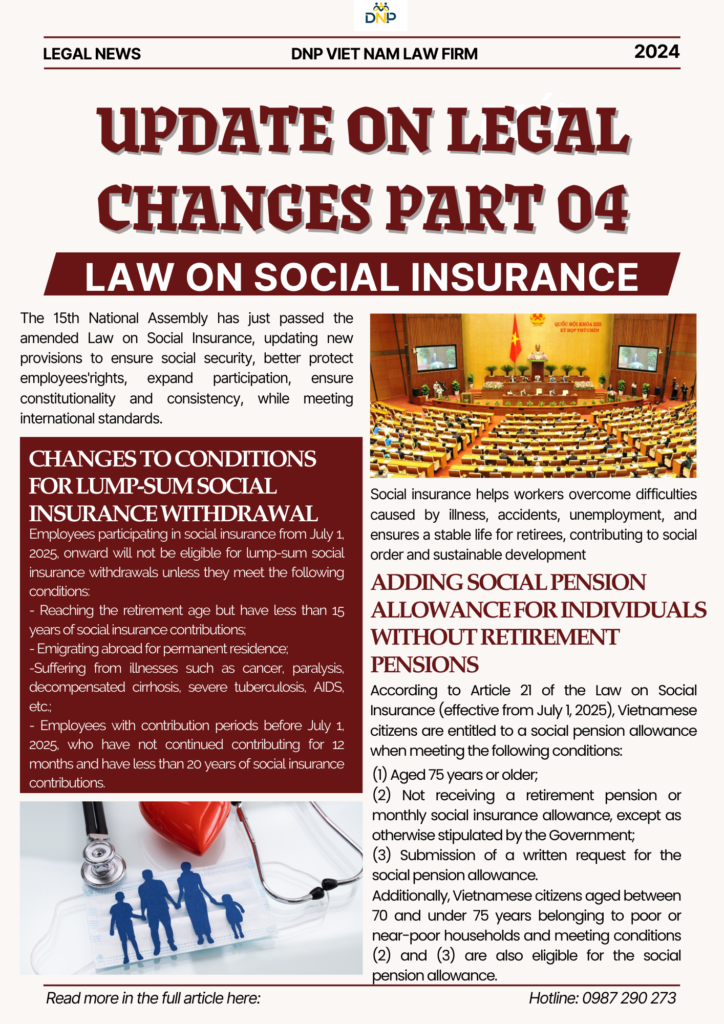
Image is designed by DNP Viet Nam Law Firm
4. Replace “base salary” with “reference level.”
The law stipulates that the “reference level” is used to calculate contributions and benefits for certain social insurance regimes. Until the base salary is officially abolished, the reference level will be equivalent to the base salary.
Note: The reference level is adjusted based on changes in the consumer price index, economic growth, and the financial capacity of the state budget and the Social Insurance Fund.
5. Changes in regulations on sick leave benefits.
a. For Short-Term Sick Leave
According to Article 45 of the 2024 Social Insurance Law, employees taking a half-day sick leave are now eligible for sick leave benefits. Specifically:
- For sick leave of less than half a day, it will be calculated as half a day.
- For sick leave of half a day or more, it will be calculated as a full day.
- The benefit for a half-day sick leave is equal to half of the benefit for a full-day sick leave.
b. For Long-Term Sick Leave
Employees with long-term illnesses are no longer entitled to a fixed 180 days of leave as previously stipulated. Instead, the duration of leave is determined based on the employee’s period of social insurance contributions and working conditions, regardless of the specific illness.
Under these new rules:
- Employees with long-term illnesses will receive 75% of their social insurance contribution-based salary during the specified leave period.
- If the specified leave period ends and the employee still requires treatment, they may continue to take leave with a reduced benefit rate.
6. All cases of abortion are entitled to maternity benefits.
According to Article 52 of the new Social Insurance Law, the leave period for employees entitled to maternity benefits in cases of miscarriage, abortion, stillbirth, or termination of pregnancy is specified as follows:
- Up to 10 days for pregnancies under 5 weeks.
- Up to 20 days for pregnancies from 5 weeks to under 13 weeks.
- Up to 40 days for pregnancies from 13 weeks to under 22 weeks.
- 120 days for pregnancies of 22 weeks or more.
7. Reduce the minimum social insurance contribution period for pension eligibility from 20 years to 15 years.
According to the drafting agency, reducing the minimum social insurance contribution period for pension eligibility from 20 years to 15 years will increase the opportunity for more people, especially those who join the social insurance system later in life, to receive a pension.
Under Articles 64 and 98 of the Social Insurance Law, workers only need to accumulate at least 15 years of social insurance contributions to be eligible for pension benefits upon reaching the required retirement age.
8. Changes in Conditions for Lump-Sum Social Insurance Withdrawal
Under the new regulations, the conditions for withdrawing social insurance as a lump sum have been amended. Specifically:
- Workers are only allowed to withdraw the portion they contributed to the social insurance fund, while the employer’s contributions remain in the fund to preserve retirement benefits.
- Exceptions to this rule are applied in cases of terminal illness, leaving the country permanently, or other circumstances as stipulated by the law.
This change aims to ensure workers retain a safety net for retirement while addressing immediate financial needs.
9. Narrowing the Scope of Relatives Eligible for Survivors’ Benefits
The scope of family members eligible to receive survivors’ benefits has been reduced under the new regulations.
Only specific categories of dependents will now qualify for survivors’ allowances, such as:
- Spouses, parents, and children who meet specific dependency criteria.
- Relatives who are financially dependent on the deceased worker, as explicitly defined by the law.
This adjustment aims to focus the benefits on the most vulnerable family members while ensuring the sustainability of the social insurance fund.
——————————————————-
DNP VIET NAM LAW FIRM
Contact:
🏢 Address: 5th Floor, 52 Nguyen Thi Nhung Street, Van Phuc estate, Hiep Binh Phuoc, Thu Duc City, Ho Chi Minh City, Viet Nam.
📩 Email: info@dnp-law.com.
📞 Hotline: 037 754 4312 (Ms.Tien).
Website: https://www.dnp-law.com/

