


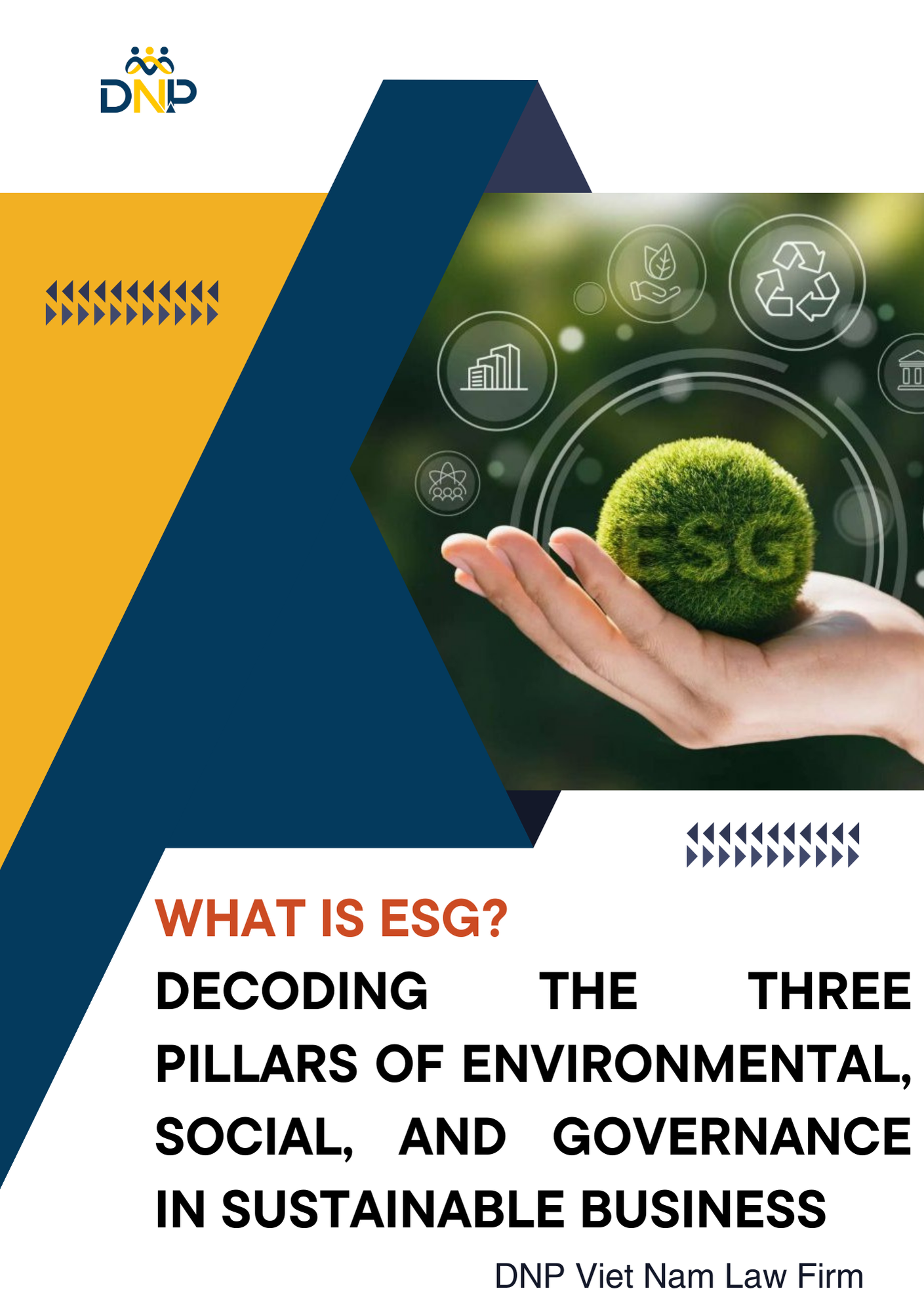
In the context of a global business environment that increasingly prioritizes sustainable development, enterprises today are expected not only to focus on profit but also to consider their environmental impact, social responsibility, and governance structure. The concept of ESG (environmental – social – governance) has become an important standard that allows investors, partners, and customers to assess a company’s sustainability and transparency.
This article, prepared by DNP Vietnam Law Firm, aims to provide legal information and an in-depth analysis of ESG, decoding its three pillars, environment, society, and governance, in sustainable business practices. It also helps enterprises identify their responsibilities, opportunities, and risks related to ESG in operations and investment decision-making.
1. Overview of ESG
- ESG comprises three components: environmental, social, and governance. It is a set of criteria used to evaluate performance not only through financial indicators but also through how a business impacts the natural environment, affects people, and structures its governance system. These standards guide enterprises toward long-term development, where economic interests align with social responsibility and governance transparency.
2. Main elements of the three ESG pillars
| Environmental (E) | Social (S) | Governance (G) |
| – The “E” pillar reflects how businesses use and impact natural resources. It serves as a critical foundation in the context of climate change and increasingly stringent environmental regulatory requirements. – Specifically, companies implementing ESG practices should: + Manage energy use and reduce greenhouse gas emissions; + Transition to renewable energy and improve resource efficiency; + Manage waste through recycling, reuse, and pollution reduction; + Protect biodiversity and ensure the sustainable exploitation of natural resources such as water, land, and forests. | – The “S” pillar focuses on a company’s impact on people and communities. A sustainable business must safeguard employee rights and create positive social value. – Key elements include: + Ensuring safe and fair working conditions as well as employee health and well-being; + Upholding customer rights, data privacy, and transparency in the supply chain; + Eliminating discrimination and avoiding forced labor or child labor; + Contributing to community development and mitigating negative social impacts. | – The “G” pillar reflects the transparency and effectiveness of a company’s governance system, a determining factor in its stability and credibility. – ESG-aligned governance requires: + A clear governance structure and effective management of conflicts of interest among stakeholders; + Truthful and transparent disclosure of both financial and non-financial information; + A comprehensive risk management system, including legal, environmental, and social risks; + Compliance with the law, integrity in business practices, and accountability. |
3. Benefits and challenges of implementing ESG
3.1. Benefits
- Enhancing reputation and attracting investment through transparency and a commitment to sustainability.
- Reducing legal and operational risks, especially in sectors with high resource use or emissions.
- Strengthening competitive advantage and improving relationships with customers, partners, and investors.
- Attracting and retaining talent through a responsible and safe working environment.
3.2. Challenges
- High initial investment costs, particularly for technological upgrades, ESG audits, and reporting.
- Lack of uniform legal frameworks and standards, making measurement and disclosure difficult.
- Limited ESG-skilled human resources, requiring training or the recruitment of specialists.
- Difficulty demonstrating immediate effectiveness, especially in the social (S) and governance (G) pillars.
“The above content is provided by DNP Viet Nam Law Firm for reference purposes only. For detailed, accurate, and tailored legal advice that meets your specific needs, please contact us using the information provided below.”
—————————————-
DNP VIET NAM LAW FIRM
🏢Address: 5th Floor, 52 Nguyen Thi Nhung Street, Van Phuc Estate, Hiep Binh Ward, Ho Chi Minh City, Viet Nam.
📞 Hotline: 0987 290 273 (Đinh Văn Tuấn Lawyer).
📩 Email: info@dnp-law.com.
Website: https://www.dnp-law.com/

