


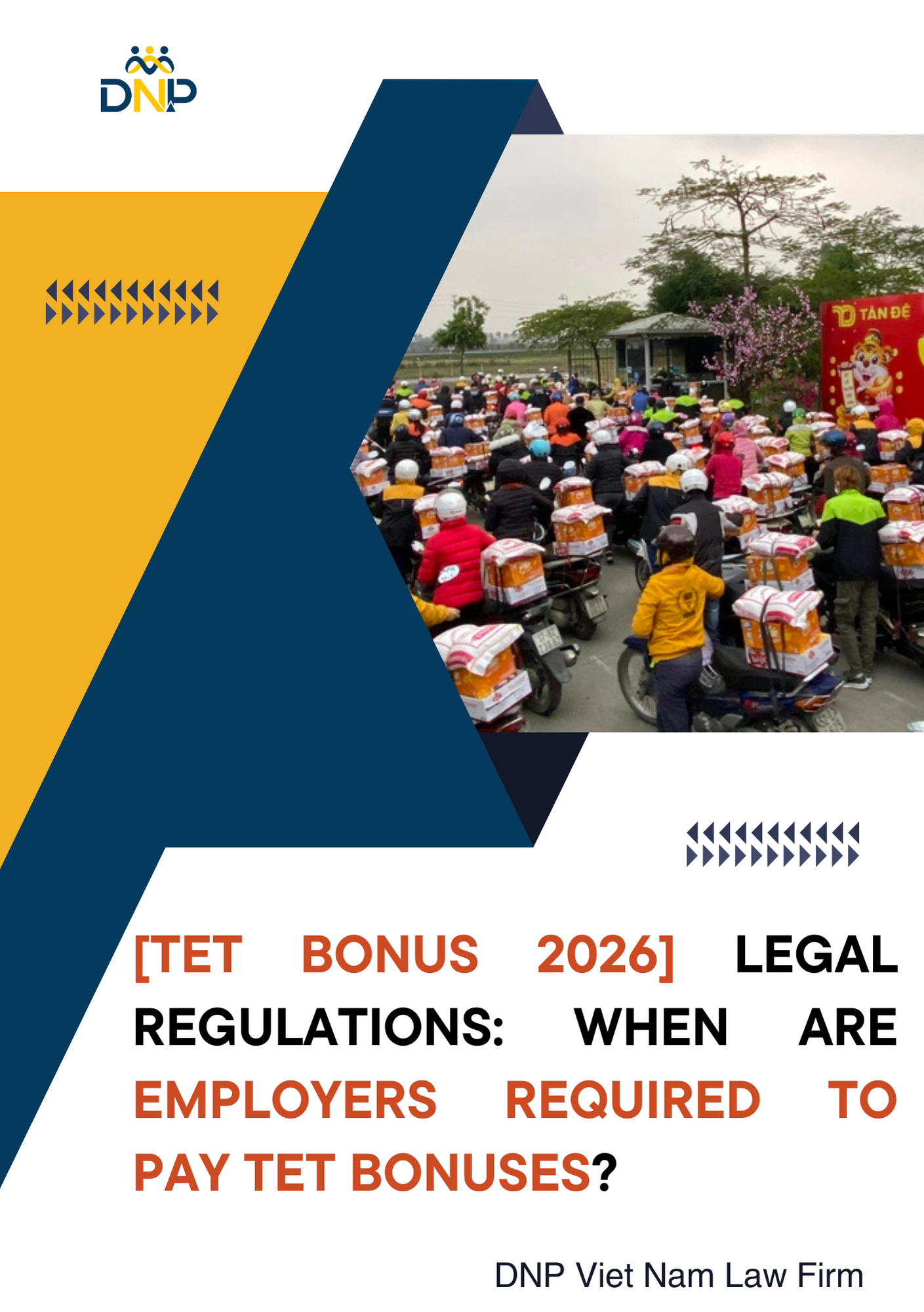
Tet bonuses are a matter of particular concern to employees at the end of each year, and at the same time constitute an issue that may easily give rise to legal uncertainties for enterprises. While many people believe that Tet bonuses are a mandatory obligation, Vietnamese labor law approaches bonuses on the basis of the principle of agreement. Properly understanding the legal nature of Tet bonuses is of significant importance in determining when enterprises incur an obligation to pay bonuses, as well as when the absence of bonuses is not considered a violation of the law.
The article below, prepared by DNP Viet Nam Law Firm, aims to provide key legal information related to the Tet bonus regime for 2026, thereby assisting enterprises and employees in correctly identifying their respective legal rights and obligations.
1. Are enterprises required to pay Tet bonuses in 2026?
Legal basis: Article 104 of the 2019 Labor Code.
- Bonuses are amounts of money or other assets granted by employers to employees based on production and business results and the level of work performance.
- The law contains no provision requiring enterprises to pay Tet bonuses, whether in cash or in kind. The payment of Tet bonuses depends on the agreement between the parties.
2. When are enterprises required to pay Tet bonuses?
Legal basis: Articles 93 and 104 of the 2019 Labor Code.
- The labor contract contains a Tet bonus clause;
- The collective labor agreement clearly provides for Tet bonuses and recognizes Tet bonuses as an entitlement of employees;
- The enterprise’s internal bonus regulations have been issued and publicly announced, and include provisions on Tet bonuses.
3. Special cases: Are cadres, civil servants, and public employees entitled to Tet bonuses in 2026?
3.1. Cadres and civil servants
Legal basis: Clause 1 Article 10 of the 2025 Law on Cadres and Civil Servants.
- Cadres and civil servants are entitled to salaries, bonuses, and other income in accordance with the results and outputs of the positions they hold, in line with the socio-economic development conditions of the country and localities.
3.2. Public employees
Legal basis: Articles 12 and 31 of the 2025 Law on Cadres and Civil Servants.
- Public employees are entitled to bonuses based on the results, outputs, and effectiveness of their job positions, as well as achievements and merits in professional activities.
- Payments are made from the bonus fund of the agency or unit and in accordance with the regulations of the public service unit.
3.3. Regulations on the 2026 bonus regime
Legal basis: Article 4 of Decree No. 73/2024/ND-CP.
- Bonuses are determined based on the results of annual performance evaluation and classification or extraordinary achievements, replacing the previous uniform and egalitarian approach.
- The specific bonus amount for each case does not necessarily have to be linked to the salary level based on individual salary coefficients.
- This bonus is paid from the annual bonus fund of the agency or unit (determined as 10% of the total salary fund) and must be disbursed within the budget year; unused amounts may not be carried over to the following year.
Currently, many localities have issued documents recommending that enterprises announce salary and bonus plans prior to Tet to stabilize labor relations (for example, Ho Chi Minh City requires enterprises to announce Tet bonuses for 2026 before December 20, 2025), but this does not constitute a legal obligation requiring enterprises to pay Tet bonuses.
“The above content is provided by DNP Viet Nam Law Firm for reference purposes only. For detailed, accurate, and tailored legal advice that meets your specific needs, please contact us using the information provided below.”
—————————————-
DNP VIET NAM LAW FIRM
🏢Address: 5th Floor, 52 Nguyen Thi Nhung Street, Van Phuc Estate, Hiep Binh Ward, Ho Chi Minh City, Viet Nam.
📞 Hotline: 0987 290 273 (Đinh Văn Tuấn Lawyer).
📩 Email: info@dnp-law.com.Website: https://www.dnp-law.com/

