


As Viet Nam increasingly emerges as a prominent destination for international real estate investment and attracts a growing number of foreign individuals seeking to own residential property in the country, understanding the “term of home ownership” applicable to foreigners has become more essential than ever. Under current Vietnamese law, there are clear limitations on the duration of ownership, the applicable conditions, and the procedures for extension applicable to foreign organizations and individuals. This article provides a detailed analysis of the legal provisions governing the term of residential ownership, exceptional circumstances, and key considerations that foreign buyers — as well as international investors — should be fully aware of to ensure that their transactions are conducted safely and in full compliance with Vietnamese law.
This article, prepared with professional consultation from DNP Viet Nam Law Firm, aims to provide readers with a clear understanding of the key legal aspects relating to the term of residential ownership by foreign individuals — one of the most discussed issues since the enactment of the Law on Housing 2023.
1. Current Legal Framework Governing Foreign Ownership of Residential Property in Viet Nam
The ownership of residential property by foreign individuals in Viet Nam is primarily governed by the Law on Housing 2023 and the Law on Land 2024. These two fundamental legislative instruments clearly define the scope, conditions, and duration under which foreigners are entitled to own residential property in Viet Nam. Both laws will take effect on 1 January 2025, replacing the previous regulations.
The Law on Housing 2023 inherits and further refines the existing framework that permits foreign individuals to own residential property in Viet Nam — an open policy aimed at attracting investment and enhancing international integration, while still safeguarding national security. In particular, Article 20 of the Law on Housing 2023 provides detailed provisions on the eligible entities, forms of ownership, and duration under which foreigners may be legally recognized as homeowners in Viet Nam.

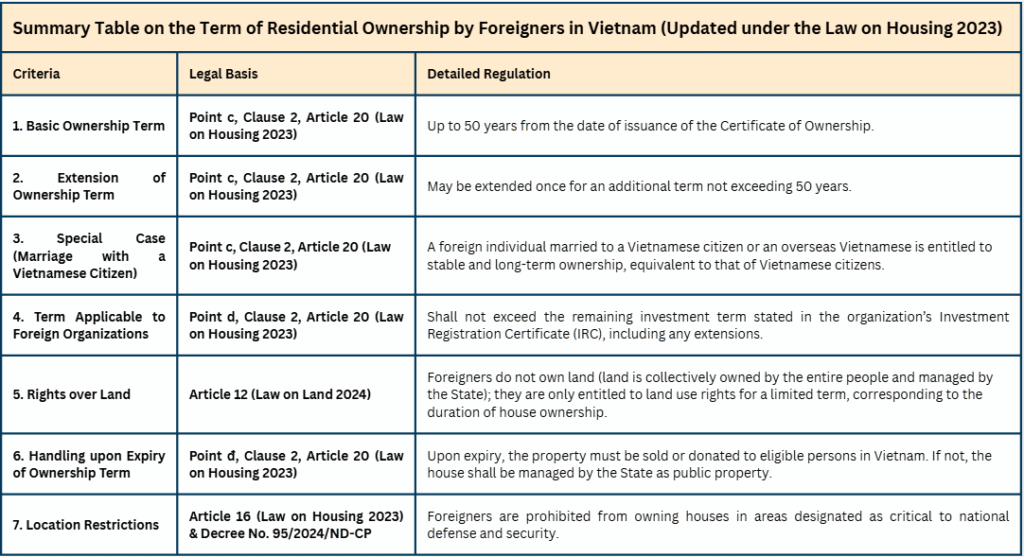
In addition, the Law on Land 2024 clarifies the legal nature of residential ownership in association with land use rights in Viet Nam. Pursuant to Article 12, land in Viet Nam is owned collectively by the entire people, with the State acting as the representative owner and exercising unified management. Foreign individuals are only entitled to land use rights for a limited term, corresponding to the duration of house ownership as recorded in the Certificate of Land Use Rights, Ownership of House and Other Assets Attached to Land. This means that foreigners are not permitted to own land on a permanent basis, but may only own the residential structures built upon such land.
Accordingly, as from 2025, all regulations concerning foreign ownership of residential property in Viet Nam will be uniformly implemented under the two aforementioned laws. These form the core legal foundation that foreign individuals and investors must thoroughly understand before entering into any real estate transactions in Viet Nam.
2. Term of Residential Ownership under the Law on Housing 2023
Pursuant to Article 20 of the Law on Housing 2023, foreign individuals are entitled to own residential property in Viet Nam through permitted forms such as purchase, hire-purchase, receipt of donation, or inheritance of commercial housing within eligible real estate projects. However, the ownership term for foreigners shall not exceed 50 years from the date on which the Certificate of Ownership is issued. This duration must be expressly stated in the Certificate and serves as the legal basis for determining the owner’s rights and obligations.
Upon expiry of the 50-year term, a foreign individual may apply for a one-time extension, with the maximum extended term of another 50 years. Such extension shall only be granted if the individual continues to satisfy the conditions for lawful residence in Viet Nam and if the housing project remains within its permitted land use duration. If the owner fails to apply for an extension or transfer the property before the expiry date, the ownership right shall automatically terminate, and the State shall revoke the ownership in accordance with the Government’s implementing regulations.
2.1. Cases Eligible for Long-Term Ownership
The Law on Housing 2023 recognizes an exception under Point (c), Clause 2, Article 20, which provides that where a foreign individual marries a Vietnamese citizen or a Vietnamese residing overseas, such person shall be entitled to stable and long-term ownership rights over residential property in Viet Nam, equivalent to those of Vietnamese citizens. This provision aims to ensure equality in marital relations and to encourage foreigners to establish a long-term connection with Viet Nam.
In addition, where a foreign individual is a member of a foreign-invested enterprise lawfully operating in Viet Nam, the ownership term of the residential property shall correspond to the operating term of such enterprise. This is a notable new provision, enhancing flexibility and facilitating long-term investment in the real estate and commercial sectors.
2.2. Significance of the Ownership Term Regulation
The limitation on the term of residential ownership for foreigners in Viet Nam represents a careful balance between an open investment policy and the protection of national sovereignty over land. The updated legal framework both enables foreigners to invest with confidence and ensures effective control over property accumulation and transfer in sensitive areas.
For purchasers, understanding the ownership term is essential not only for effective investment planning but also for avoiding potential risks upon expiration. All relevant information concerning the duration of ownership, extension conditions, or transfer procedures should be clearly stipulated in the sale and purchase contract and registered with the competent authority to secure legal validity and long-term protection of ownership rights.
3. Procedures for Extension, Transfer, and Practical Considerations
3.1. Regulations on Transfer and Inheritance of Residential Property
During the valid ownership term, foreign individuals may transfer, donate, or bequeath residential property in accordance with Point (đ), Clause 2, Article 20 of the Law on Housing 2023. Such transfer must be conducted under a notarized or certified contract and registered for title transfer with the Land Registration Office. Where the transferee is a Vietnamese citizen or an overseas Vietnamese, he or she shall be entitled to permanent ownership rights over the property.
If the transferee or heir is also a foreign individual, the ownership term shall be limited to the remaining duration recorded in the former owner’s Certificate. Upon the expiration of such term, if no transfer or extension procedure has been completed, the ownership right shall terminate, and the property shall be handled in accordance with Vietnamese law. Foreign owners are therefore advised to regularly monitor the validity of their ownership to proactively plan future transactions.
3.2. Key Practical Notes
When conducting property transactions in Viet Nam, foreign individuals must ensure that all payments are made through licensed credit institutions or lawful banks, in compliance with regulations on foreign exchange control and transaction transparency. Purchasers should also carefully verify the legal status of the project, ensuring that it is included in the list of developments permitted for sale to foreigners as announced by the Ministry of Construction.
Additionally, arrangements in which a Vietnamese nominee holds ownership on behalf of a foreigner carry significant legal risks, potentially rendering the transaction invalid and resulting in the loss of ownership rights. All procedures should therefore be transparent, lawful, and conducted with professional legal counsel specializing in investment and real estate to safeguard the foreign buyer’s interests.
4. Conclusion & Recommendations from DNP Viet Nam Law Firm
The regulations on the term of residential ownership for foreigners under the Law on Housing 2023 and the Law on Land 2024 open substantial opportunities for foreign investors to participate in Viet Nam’s domestic real estate market, while maintaining transparency and reasonable control. The statutory limits on ownership duration, transaction conditions, and investment scope not only protect the rights of all parties but also uphold market stability and national security.
Nevertheless, the legal framework governing foreign ownership of residential property requires in-depth understanding and strict compliance with administrative procedures. Foreign individuals should pay close attention to residency conditions, extension terms, ownership limits, and the legal validity of the project before executing any purchase contract. Proper preparation of documentation, legal due diligence, and long-term ownership planning are crucial to ensuring investment safety.
👉 DNP Viet Nam Law Firm, with a team of experienced lawyers specializing in real estate, investment, and foreign-related legal matters, offers comprehensive advisory services on:
- Assessing eligibility and lawful ownership terms for foreigners in Viet Nam;
- Conducting procedures for purchase, transfer, or extension of ownership rights.
- Drafting and reviewing contracts to protect the legal interests of foreign investors.
For detailed consultation or specific legal assistance, please contact DNP Viet Nam Law Firm for dedicated guidance and professional support throughout every stage of your real estate transaction in Viet Nam.
DNP VIET NAM LAW FIRM
Contact:
🏢 Address: 5th Floor, 52 Nguyen Thi Nhung Street, Van Phuc Estate, Hiep Binh Ward, Ho Chi Minh City, Viet Nam
📩 Email: info@dnp-law.com
📞 Hotline: 0987 290 273 (Dinh Van Tuan Lawyer)
Website: https://www.dnp-law.com/

