


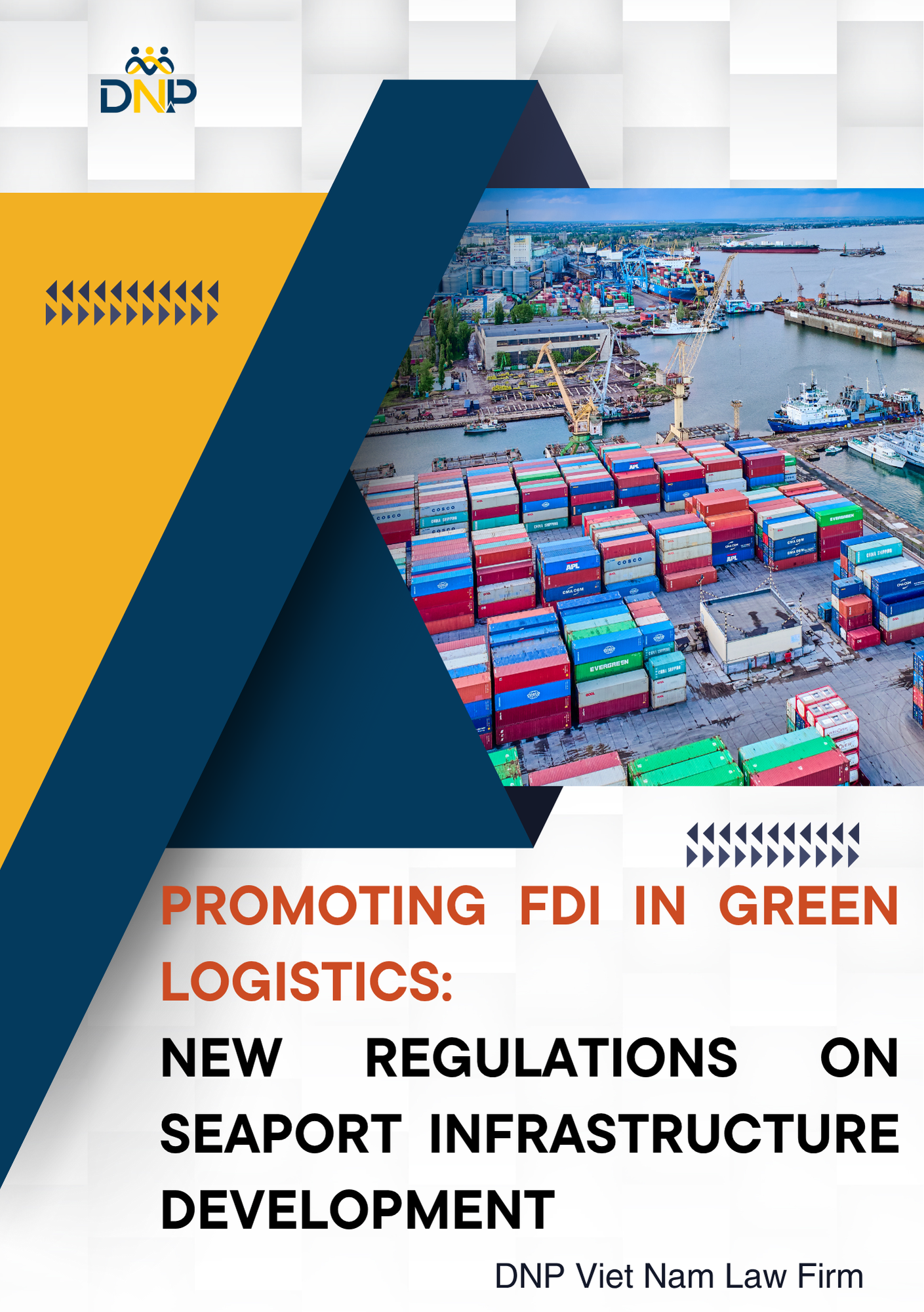
Green logistics is emerging as a key focus area for attracting foreign direct investment (FDI) in Vietnam, particularly in the development of seaport infrastructure. Greening the logistics sector enables businesses to meet environmental standards, enhance competitiveness, and promote sustainable growth. In response to this inevitable trend, various new legal regulations have been issued to support investors.
The following article, prepared by DNP Viet Nam Law Firm, provides essential legal insights into newly introduced policies related to the development of green seaport infrastructure, aiming to support FDI in green logistics in Vietnam.
1. Definition of Green Logistics and Seaport Infrastructure Development
- Green logistics refers to logistics activities that aim for sustainability and environmental protection by minimizing negative impacts on the environment (as defined in the Vietnam Logistics Report 2022).
- Seaport infrastructure development involves investing in and upgrading ports, warehouses, and connected facilities to support logistics operations. In the current context, seaport infrastructure is being oriented toward green standards, integrating low-emission technologies and renewable energy solutions to align with the national commitment, to sustainable transition and green growth.
2. Incentive policies for FDI in green logistics and seaport infrastructure development
2.1. Tax incentives for investment in green logistics
Legal basis: Point a, Clause 1, Article 13 and Point a, Clause 1, Article 18 of the Law on Corporate Income Tax 2025 (effective from October 1, 2025); Point c, Clause 11, Article 16 of the Law on Export and Import Duties 2016.
- A 10% corporate income tax rate for 15 years applies to investment projects in seaport infrastructure development.
- Corporate income tax exemption for 4 years and a 50% reduction in payable tax for the subsequent 9 years is granted to enterprises generating income from newly established investment projects.
- Import duty exemption is applicable for imported goods used to form fixed assets for investment projects in preferential sectors.
2.2. Land use incentives for green logistics projects
Legal basis: Articles 79, 87, 88 and Point c, Clause 1, Article 172 of the Land Law 2024; Decree No. 88/2024/NĐ-CP.
- Land lease term extension of up to 50 years: Land allocation or lease duration for investment projects is determined based on the project lifespan or the investor’s proposal but must not exceed 50 years.
- Land clearance and compensation support: The State may assist with site clearance and compensation procedures for land recovery associated with investment projects.
Image designed by DNP Viet Nam Law Firm
3. FDI in green logistics – A driving force for investment environment and sustainable seaport infrastructure in Vietnam
Referenced documents:
(1) Law on Investment 2020;
(2) Decision No. 2027/QĐ-BGTVT dated 2020 on approving the Green Port Development Scheme in Vietnam;
(3) Government e-portal, article “Vietnam proactively implements COP26 commitments”, dated 01/11/2023;
(4) Portal of the Directorate for Standards, Metrology and Quality: “Applying international standards in GHG inventory: Enterprises benefit greatly”, dated 16/08/2024;
(5) Tạp chí Dân tộc and Tin tức, article “Developing ecological port standards,” dated 03/06/2019; and “Mobilizing financial resources to boost green growth investment”, dated 27/06/2025;
(6) Vietnam Law Newspaper Online, article “Green logistics is the key for Vietnamese enterprises to overcome global volatility”, dated 11/07/2025;
(7) Banking Times, article “Green financial policies promote green logistics development”, dated 31/07/2025.
- Technology transfer and adoption of international standards: FDI enterprises contribute advanced systems such as ISO 14001 environmental management, ISO 14064 greenhouse gas inventory and the EcoPorts model, enhancing operational efficiency and emissions transparency.
- Long-term capital mobilization: FDI addresses the financing gap in green logistics infrastructure, facilitating the deployment of investment projects in green port infrastructure, electrified operational equipment, and energy-efficient systems.
- Direct investment in green seaport infrastructure: Foreign investors participate in retrofitting seaports to green standards (emissions reduction, renewable energy use, wastewater treatment, air quality management) and engage in PPP projects initiated by the State to share risks and optimize development resources.
- Development of cross-border green supply chains: Green logistics FDI promotes international logistics integration through commitments under COP26 and COP27, implementation of carbon tracking and traceability, and adherence to ESG standards (environmental, social, and governance) across transportation, warehousing, and distribution activities.
“The above content is provided by DNP Viet Nam Law Firm for reference purposes only. For detailed, accurate, and tailored legal advice that meets your specific needs, please contact us using the information provided below.”
—————————————-
DNP VIET NAM LAW FIRM
🏢Address: 5th Floor, 52 Nguyen Thi Nhung Street, Van Phuc Estate, Hiep Binh Ward, Ho Chi Minh City, Viet Nam.
📞 Hotline: 0987 290 273 (Đinh Văn Tuấn Lawyer).
📩 Email: info@dnp-law.com.
Website: https://www.dnp-law.com/

